If you’re learning French, one of the first confusing things you’ll notice is this:
English has one word — “you.”
French has two: tu and vous.
So… which one should you use?
In this guide, you’ll learn:
- When to use tu
- When to use vous
- Cultural differences
- Tricky real-life situations (work, in-laws, internet)
Quick Answer
In French:
- Tu = singular and informal
- Vous = formal OR plural
But in real life, it’s more about relationship and social distance than grammar.
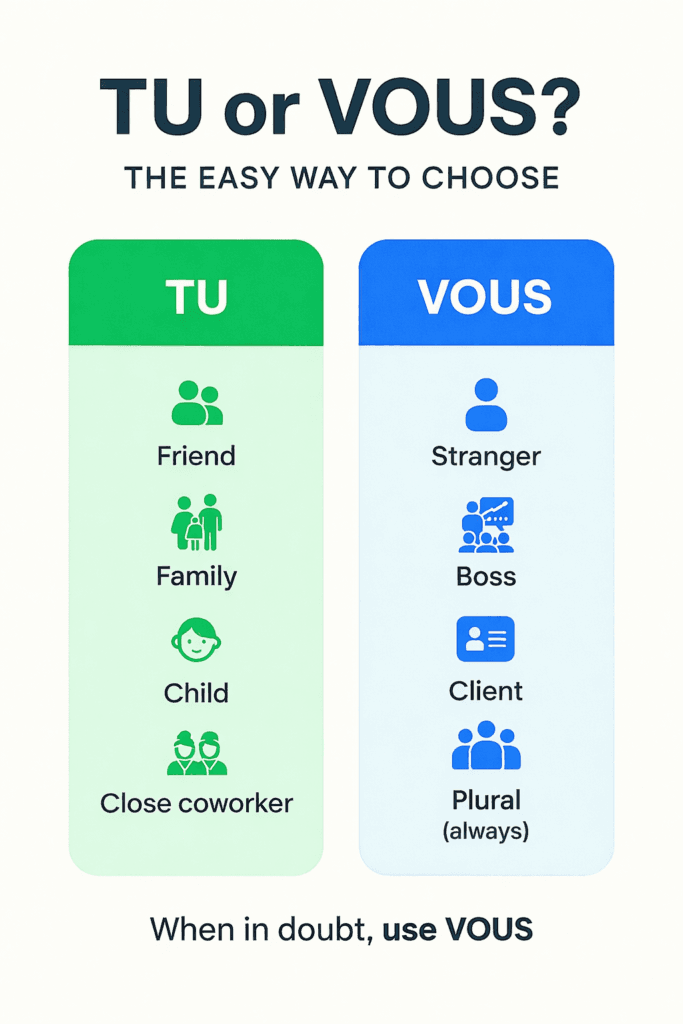
When to Use Tu
Use tu when speaking to:
- Friends
- Family members
- Children
- Classmates
- Close coworkers
- People your age in informal settings
Example:
Tu viens ce soir ?
(Are you coming tonight?)
Key idea:
“Tu” signals closeness, familiarity, equality.
When to Use Vous
Use vous when speaking to:
- Strangers
- Older people (in many contexts)
- Your boss
- A client
- Someone you want to show respect to
- More than one person (plural)
Example:
Vous travaillez ici ?
(Do you work here?)
⚠️ Important:
Vous is ALWAYS used for plural, even with friends.
Vous venez ce soir ?
(Are you all coming tonight?)
Cultural Difference: It’s Not Just Formal vs Informal
For English speakers, this is often surprising.
In English, switching to first names feels informal.
In French, switching from vous to tu can feel like a small social milestone.
There are even verbs for it:
- tutoyer = to use “tu”
- vouvoyer = to use “vous”
You might hear:
On peut se tutoyer ?
(Can we use “tu” with each other?)
That’s a sign of growing familiarity.
Tricky Real-Life Situations
At Work
- Start with vous
- Switch to tu if your colleague suggests it
- In startups, “tu” is common
- In traditional companies, “vous” may stay
With In-Laws
Depends on the family.
- Some families use tu immediately
- Others prefer vous for parents-in-law
If unsure, start with vous.
On the Internet
Interesting evolution:
- Social media → mostly tu
- Customer service emails → vous
- Marketing → usually vous (neutral and inclusive)
With Teachers
In France:
- Students say vous to teachers
- Teachers say tu to students (in school)
At university, students still say vous.
What Happens If You Use the Wrong One?
Using vous instead of “tu”:
- Sounds polite
- Maybe slightly distant
Using tu instead of “vous”:
- Can feel too familiar
- Sometimes slightly rude
👉 If unsure: choose vous.
It’s the safe option.
Summary Table
| Situation | Tu | Vous |
|---|---|---|
| Friend | ✅ | ❌ |
| Stranger | ❌ | ✅ |
| Boss | ❌ | ✅ |
| Children | ✅ | ❌ |
| Several people | ❌ | ✅ |
| Social media | ✅ | Sometimes |
Common Mistakes English Speakers Make
❌ Thinking “vous” is only formal
✔ It is also plural
❌ Using “tu” with a shop assistant
✔ Use “vous”
❌ Switching randomly
✔ Let the French person guide the switch
FAQ
Can I always use “vous” in France?
Yes. It may sound distant with friends, but it is never rude.
Do French couples use “vous”?
Almost never. They use tu.
Do French people switch quickly to “tu”?
It depends on age, context, and personality.
Learning French isn’t just about grammar, it’s about:
connecting with people, understanding a culture, and gaining new confidence. And I’d love to support you on that journey.
So… are you ready to say:
“Oui, je parle français!”
YES, I SPEAK FRENCH!